What does it mean to tell a story? Narrative, at its core, is concerned with change. A depression or improvement in the state of affairs. A stroke of good luck which lifts a character to better circumstances. An apocalyptic misfortune that reduces once-thriving societies to rubble. The stories we tell map change, and in the rare event that they don’t concern the change themselves, they are about the consequences of an offstage change, the reactions, the prevention, or otherwise the impacts of said fluctuations. But to experience change, we have to move forward in time. J. Miller claims that ‘It’s about time. All literature is about time.’ (Miller, 2003) and indeed it seems that the marching of time is a fundamental prerequisite in this chronicling of change that we call storytelling. In order for change to occur, narrative must respect the linearity of time.
Typical fictions, in the sense of entirely text-based novels, have only to ensure that they respect the continuity of time in one dimension. The sentences and word choices which make up the stories they tell must defer to time in order to enact change, but this is all the novelist has to bear in mind. However, the outbreak of the formally-termed graphic novel in the mid-1960s (historian Richard Kyle coined the term ‘graphic novel’ in an essay featured in the November 1964 edition of the ‘Capa-Alpha’ magazine (Schelly. 2010)) revolutionised the way that stories interact with change, and as a result, time.
Now, the author had to respect the chronology of time in two dimensions; in the textual narratives they wrote, and further still in the illustrations which adorned their written fictions. The invention and popularisation of the graphic novel, and especially the experimental graphic novel, re-formed how our stories engage with time. To understand exactly the significance of this shift in storytelling capability, this essay will begin by first exploring what the genre of the graphic novel – and particularly the experimental graphic novel – is; its hallmarks, evolution, and conventions. After securing an understanding of the genre, this essay will explore the unique ability of the experimental graphic novel to engage with time in multiple dimensions – using a particular focus on Richard McGuire’s ‘Here’ and Fabio Moon’s ‘Daytripper’ in order to do so – before finishing by considering how this expansion in our narrative-forming abilities has impacted both the process and the reception of literature.
But what is a graphic novel? Typically, the term is considered to be distinct from a ‘comic book’, which is itself generally used for comics series and periodicals (Phoenix, 2020), as ‘graphic novel’ tends to relate more to a standalone story. Historically however, the two have been used interchangeably. Nevertheless, broadly we might take the graphic novel to be a series of panels or pages of illustration which accompany some kind of
minimally-text based, but present, narrative in one cohesive book or production. An experimental graphic novel, such as ‘Here’ and ‘Daytripper’, is one which uses this formal method to explore, challenge, or otherwise contend with a boundary in style or content. As we shall see, both ‘Here’ and ‘Daytripper’ break conventions in form and content in order to better portray the advance of time.
Where did the graphic novel come from? The origins of the form are contentious, because as noted, the definition of the graphic novel itself is hotly contested. The Merriam-Webster’s dictionary defines it as ‘a fictional story that is presented in comic-strip format and published as a book’ (Merriam-Webster, 2025). However, given the dispute around its definition, it is difficult to pinpoint the outbreak of the graphic novel form in world literature.
Nevertheless, ‘The Adventures of Obadiah Oldbuck’, dated from a Swiss publication in 1828 and published in English in 1841, is often provided as the first ‘graphic novel’ which satisfied the above definition (Coville, 2007). The wider genre didn’t begin to take shape until 1894, when Russo-French cartoonist Caran d’Ache started work on a 360-page wordless book which he termed a ‘drawn novel’ (Groensteen, 2015), though the project was never completed. Nevertheless, this suggestion demonstrates the beginning of a renaissance in understanding that storytelling and fiction in literature might not have to take place through sentence alone. d’Ache and his co-conspirators in the ‘drawn novel’ project began a revival of the medium of storytelling through images that has its heritage in the earliest cave-drawings of Cáceres, Spain, dated from 64,000 years ago (Hoffman et. al, 2018). Since that time, humans have chronicled their lives in narratives by drawing them; the written story is an innovative development in comparison, dating only back to 2100 BCE with the ‘Epic of Gilgamesh’ (Brandāo, 2020). The revival and codification of the ‘drawn’ novel by d’Ache which precipitated the ‘graphic’ takes us back to these roots, to our primitive mode of constructing narrative in order to make meaning in our lives; picture-drawing.
Moving from d’Ache into the 20th century, the graphic form exploded in formality and popularity. The launch of ‘Classics Illustrated’ in the mid-1940s, a series that adapted classic and important novels into the graphic form, greatly increased popular awareness and demand for the illustrative fiction.
By the late 60s, the form was arguably as respected in the literary field as its textual counterpart. Indeed, author John Updike addressed the Bristol Literary Society on ‘the death of the novel’, and explained that he ‘saw no intrinsic reason why a doubly talented artist might not arise and create a comic strip novel masterpiece’ (Gravett, 2005). Signalled by Updike’s blessing, the graphic novel had cemented itself as a storytelling vehicle in literary culture.
So how does the experimental graphic novel utilise time in a way which is inaccessible to its textual counterparts? Unlike the author of the classic novel, the illustrator has greater control over the imaginative picture which fills the readers’ mind as they digest whatever fiction they are reading. Typically, the best the author can do is use evocative and metaphorical language. Take this passage from the supreme American novel, ‘The Great Gatsby’:
“Gatsby himself didn’t believe it would come, and perhaps he no longer cared. If that was true he must felt that he had lost the old warm world, paid a high price for living too long with a single dream. He must have looked up an unfamiliar sky through frightening leaves and shivered as he found what a grotesque thing a rose is and how raw the sun light was upon the scarcely created grass” (Fitzgerald, 2004)
Fitzgerald is often hailed as one of the most expressive writers in American fiction, but even in this wonderfully redolent passage, there is room for discrepancy in the readers mental-image. Questions as blatant as; what kind of leaves? What did the grass look like? Were there clouds in the sky?
These questions, whilst irrelevant to building plot or character sincerity, or indeed to the passage of time in the novel, demonstrate that with textual narrative, there is much room in the readers mind to interpret the sentences into whatever aesthetic experience they desire. This is not so much the case with the experimental graphic novel; the illustrator, by their very nature, is able to provide an exact, specific mental image to the reader – by providing a physical one. By removing the ambiguity which comes with converting text into image, the graphic novelist is better equipped to convey a specific sentiment or set of circumstances with a reduced risk of misinterpretation, especially when it comes to something as easily misunderstood and often crucial to the narrative as the passage (or lack thereof) of time.
Understanding this privilege of the graphic novel, and exactly how the illustrator wrangles time in multiple dimensions, requires a particular interrogation of the works of McGuire and Moon. Richard McGuire’s ‘Here’ is an experimental graphic memoir which takes a singular spatial location and imagines it over a broad temporal spectrum, ranging from 500,957,406,073 BC to the year 2033 AD. – what may have been a living room in 1947 was the middle of a forest in 1753, or a nuclear wasteland in 2031. The project acts as a pushback against the tyranny of time, reaching across temporal borders in order to present a singular space, in multiple moments.
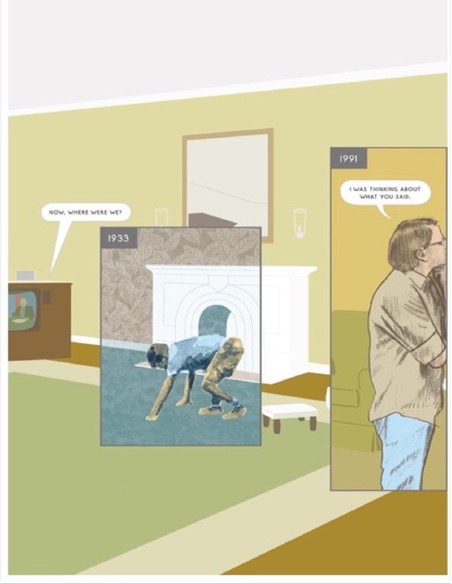
In the above frame, we can note the manifold portrayal of time which McGuire achieves, by layering several temporal moments on top of a singular spatial one (McGuire, 2014). In the same room in which a man might have stood, finishing a conversation in 1991, a boy might’ve posed, crouched in some kind of athletic start, in 1933. Through his illustration, on a single page McGuire
shows us the versatility of time, bringing multiple moments into one cohesive unit. This can only be achieved, with the level of clarity and distinctness, through illustration. To portray the same notion in text alone seems an arduous task, and even if this magnitude of temporality could be recorded, the mental-image would be subject to distortion in the reader’s mind. Rather, it is the special privilege of the graphic novelist, by combining the dimensions of the written word with their illustrative embellishments, to so wholly and without confusion capture this particularly hazy and intricate idea of the stratification of time. “Graphic novels often concretize literary ambiguity”, as Elaine Martin (2011) pointed out, and ‘Here’ certainly does turn the mysticism of the orbit of time into a digestible graphical representation.
Similarly, Fabio Moon’s ‘Daytripper’, a ten-issue comic later converted into a cohesive book unit, plays with the tyranny of time in a way often inaccessible to classic fiction. ‘Daytripper’ follows the life of one man, Brás de Oliva Domingos, through various moments, exploring the choices he makes and the different paths his life could take. Similarly to McGuire’s work, Moon’s production plays with the passage of time and the way memories shape our understanding of the present – each ‘episode’ ends with a different version of Brás’ death, and in each he tackles one of life’s biggest questions; arising from the dead in the next ‘episode’ simply to contend with another.
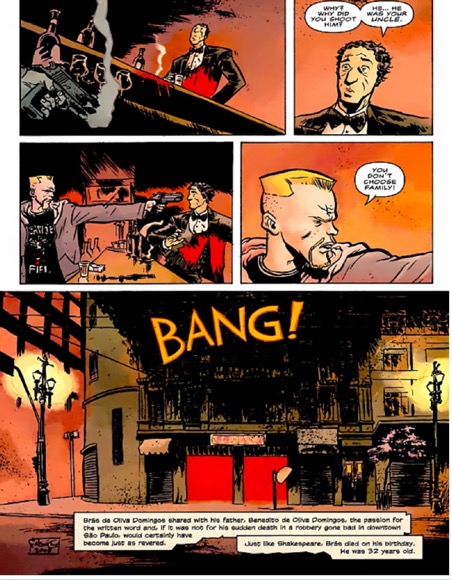
In the above scene, Brás dies from a mishandled robbery, and reflects on his priorities in life – his choice to pursue his authorial desires over the relationships closest to him (Moon, 2010). However, Moon then invokes an atypical chronology by reviving, resetting, or otherwise restoring Brás in the following scenes or episodes, where he dies in a plane crash, of a heart attack,
by firing squad, or indeed of old age; each one teaching him a different life lesson, each one forcing him to confront a different aspect of what it means to be a human.
In very different ways, both ‘Here’ and ‘Daytripper’ refuse to bow to the tyranny of linear time. Unlike textual narratives, they use multiple dimensions to briefly take the reader outside of time, to allow them to jump back and forth through ages, across death, and outside of the present as they please. The illustrative capacity of these novels, which is not accessible in typical fiction, is what allows them to do this with such clarity, and what guarantees the consistency of their output. There is no mistaking the imaginative image that McGuire hopes to convey by his layering of time, when the exact physical illustration is provided on the page. There is no confusion in the incredulity of Brás being on the next page, when the reader just saw him die on the operating table in the scene before. But by combining their stable narratives with these illuminating drawings, these novels manipulate time with a dexterity and decisiveness which was previously unavailable, which always carried with it an interpretive volatility in the soley written word. It was not possible to know with certainty, when the novelist would subvert time in typical narratives, exactly the kind of vision they had in mind. We map our own lives onto the sentences of these fictions, and we make our own corresponding images as a consequence. But the graphic novel, with its authoritative optics, stewards time in a way that lacks insecurity, that lacks interpretive room.
The popularity and critical approval of both ‘Here’ and ‘Daytripper’ point to a shift in the storytelling landscape which favours the illustrative. One which celebrates the graphic novel for its condensation of ‘the complexity of modern life with its babble of signs and symbols and stimuli’ (Campbell, 2007). Once again, we are finding ourselves searching for a way to express our truest and deepest feelings in a way that words alone cannot capture, and we turn to the graphic to allow us the chance to express ourselves in this way.
Revealed by both McGuire’s and Moon’s projects is the importance of visual literacy. Not just for digesting the inevitability of time, but in the broader pedagogical domain also. Reading comprehension experts ‘often suggest teaching students to visualise what they’re reading, and even draw pictures of it, to increase comprehension and retention’(Pagliaro, 2014). A picture is worth a thousand words, it is often said. But when it comes to understanding the world around us, to understanding ourselves, perhaps the graphic is worth even more. Graphic novels, through the subtlest choices – a unique shade of red, the sharpness of a character’s jaw, the interior décor of a particular setting – can spark revelation in us, can lead us to better recognise or understand our own lives.
Ultimately, this is what the graphic novel has changed about the enterprise of literature. By understanding exactly how the experimental graphic novel is able to contort time in multiple dimensions, we unlock an appreciation for the breadth of the graphic novel’s capabilities, a breadth unmatched by its textual counterparts. In this breadth lies the expansion of storytelling operation that graphic novels provide – the unique ability to present an exact mental image, one devoid of interpretation and distortion. By presenting this specific mental image, the graphic novel can better communicate a precise sentiment to its audience, without having to rely on their uniform reaction to a string of adjectives. Charles Hatfield said, ‘The interplay of word and image in comics is not merely additive but synergistic, creating meaning that neither element could produce alone’ (2005), and indeed this combination of pictorial representation with a structured narrative in both Moon’s and McGuire’s novels creates a level of meaning and understanding which cannot be done by word (or simply illustration) alone. ‘Here’ and ‘Daytripper’ take our two foremost storytelling methods and combine them, expanding storytelling beyond the individual capabilities of either form. The experimental graphic novel gives us a version of narrative that speaks to us in the truest, most human way.
BIBLIOGRAPHY
Brandāo, J. (2020) The history of writing systems: from cave paintings to alphabets. Oxford: Oxford University Press.
Campbell, E. (2007) ‘What Is A Graphic Novel?’ World Literature Today, 81(2), pp. 13-15.
Coville, J. (2007)’The History of Comic Books: Introduction and “The Platinum Age 1897-1938”, [online] TheComicBooks.com, Available
at: https://web.archive.org/web/20030415153354/http://www.collectortimes
.com/~comichistory/Platinum.html [Accessed 25 Apr. 2025].
Fitzgerald, F.S. (2004) The Great Gatsby. London: Penguin Classics.
Gravett, P. (2005) Graphic novels: everything you need to know. London: Harper Design.
Groensteen, T. (2015) Comics and narration. Jackson: University Press of Mississippi.
Hatfield, C. (2005) Alternative comics: an emerging literature. Jackson: University Press of Mississippi.
Martin, E. (2011) ‘Graphic Novels or Novel Graphics?’, The Comparatist, 35,
pp. 170-181.
McGuire, R. (2014) Here. New York: Pantheon Books.
Merriam-Webster (2025) Graphic novel. [online] Merriam-Webster.com.
Available at: https://www.merriam-webster.com/dictionary/graphic%20novel [Accessed 26 Apr. 2025].
Miller, J.H. (2003) On literature. London: Routledge.
Moon, F. and Bá, G. (2010) Daytripper. New York: Vertigo.
Pagliaro, M.A. (2014) ‘Is A Picture Worth A Thousand Words’, The English Journal, 103(4), pp. 31-45.
Phoenix, D. (2020) ‘Comics vs. graphic novels: what’s the difference?’ [online] The Comics Journal. Available
at: https://www.tcj.com/comics-vs-graphic-novels [Accessed 26 Apr. 2025].
Schelly, W. (2010) Founders of comic fandom: profiles of 90 publishers, dealers, collectors, writers, artists and other luminaries of the 1950s and 1960s. Jefferson, NC: McFarland.

Leave a comment