In his celebrated video essay ‘the answer is not a hut in the woods’, exurb2a seeks inspiration and fulfilment through isolation in nature, only to find that true contentment lies in developing personal connections and relationships. He realises that solitary escapism will not help to solve his creative struggles or emotional battles. Certainly, he is right to conclude that it is principally through nurturing our close bonds and connecting with friends and family that we might dig ourselves out of these ruts into which we increasingly fall.
Nevertheless, I think his account does miss something of the importance of our surroundings, failing to recognise the profound effect that the architecture and natural landmarks around us have on our creative output.
Art is inseparable from its context, its ‘aura’ as Walter Benjamin put it – the specific time and place in which it was created. A 1:1 copy of
Hopper’s Nighthawks, made today with all the same materials and brushstrokes and assembled in exactly the same order, perhaps even if it was done by Hopper himself, would lack something of the original, Benjamin contends. It would lack that geo-temporal aura, that particular insignia of its time and place of creation.
Benjamin means place here in the broad sense – the country, perhaps the city, and even then maybe going as far as to say simply particular artistic movements or styles associated with a certain geographical fulcrum. But what if we zoom in? Can’t we take place to mean equally the literal surroundings of the artist? The high ceilings, the cramped garage workshop, the glitzy modern studio? There’s research demonstrating the cathedral effect; the height of the ceiling under which you work really does influence the creativity of your thinking. Lower ceilings promote more detail-oriented thinking, and higher ceilings encourage freer and more creative cognition.
Wouldn’t it make sense to look at a piece of art and wonder: how might this have looked different if it was painted in a studio with bigger windows? with more natural light? How would this have changed if it had been created in a basement?
We’re influenced by our surroundings, and in our era of sterilised, brutalist, uninspiring suburbia, it’s no wonder we’re faced with an ever-growing scarcity of creativity. We look at our architectural backdrop, and we’re met with the same blank stares we give to the canvas in front of us. Long gone are the colourful, towering statues of Ancient Greece and Rome, or the tessellating spires of a Byzantine church. No longer can we draw our inspiration from sky-piercing gothic cathedrals, or impossibly methodical pyramids. But we have pre-fabs. We have 12-storey car parks and apple stores with fake foliage for an ‘organic look’ and brutalism. Even the name’s depressing.
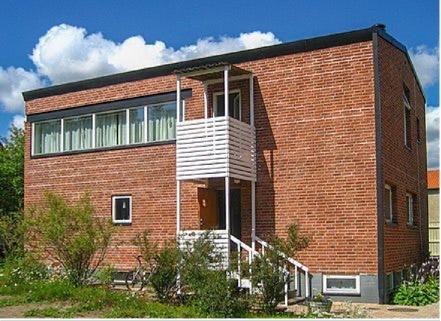
‘Villa Goth’, in Uppsala, Sweden.This house birthed the phrase ‘New Brutalism’ (nybrutalism).
Brutalism is a style of architecture born of the reconstruction efforts of 1950s, postwar Britain. Said to have been a reaction against the nostalgia of architecture in the 1940s, brutalism featured heavily in the designs of socialist-influenced, low-cost council housing and institutional buildings.
Brutalism has drawn much criticism in the UK, often being described as ‘cold’ and ‘totalitarian’. One of the key motifs of brutalist design is ‘functionalism’ – a particular aspect being designed to serve its purpose most efficiently, and nothing more.
This is the great issue with modern architecture (not all of which is brutalist, of course, but which often shares the same focus on function over form).
Phrases like ‘modular elements’, ‘formal legibility’ and ‘functional zones’ preside over these building plans, doing away with the grand, sprawling designs of art nouveau doorways and resolving to use raw concrete – after all, it is cheaper. The result is that we end up surrounded by towering concrete blocks, rectangles with uniform windows and symmetrical faces. In every direction confronted by repetitive, soulless edifices. It’s no wonder we find it harder to be ‘inspired’ than ever before.
The answer might be a hut in the woods. Not for the isolation angle; we know how important sustained and valued social relationships are for creativity, as well as basic human survival. Rather, a change of scenery – literally – has never been more valuable. Nature has no scheming architect, and its designs are more varied and complex than many of the neighbouring structures. It doesn’t have to be a hut in the woods, and you don’t need to stay long; no need to live out of a cave like Heidegger. But by leaving the retail parks behind and connecting with nature, you might find a new way of approaching the page.
See what you can create without being suffocated by the ‘concrete jungle’ we so affectionately named.
If you’re lonely or uninspired, isolation is not the answer. Engaging with others and cultivating your relationships is far more helpful for overcoming mundanity. But retreating into nature, escaping the functional architecture which surrounds our everyday life, may do wonders for your creativity. The answer might be a hut in the woods.

Leave a comment